How Hard Is the Water in North & Central Jersey? A Homeowner’s Guide.
If you live in North or Central Jersey and have noticed white spots on your faucets, cloudy glasses, soap scum, or scale around your showerhead, you may be dealing with hard water in North Jersey or a nearby Central Jersey water system.
But exactly how hard is the water in North & Central Jersey?
The answer depends largely on where you live and where your water comes from.
Two homes just a few towns apart can have very different water hardness levels. One may receive relatively soft surface water from a regional utility, while another may rely on groundwater that has picked up large amounts of calcium and magnesium as it moves through local rock formations.
That is why knowing your town—or even your county—is not always enough. The best way to understand your water is to know your water source and test the water entering your home.
What Does “Hard Water” Actually Mean?
Water hardness refers primarily to the amount of dissolved calcium and magnesium in your water.
These minerals occur naturally. As rainwater moves through soil and rock, it dissolves small amounts of minerals before eventually entering underground aquifers, wells, reservoirs, and public water supplies.
The U.S. Geological Survey uses the following general classifications for water hardness:
| Hardness | mg/L or ppm as CaCO₃ | Approx. grains per gallon |
|---|---|---|
| Soft | 0–60 | 0–3.5 gpg |
| Moderately hard | 61–120 | 3.6–7 gpg |
| Hard | 121–180 | 7.1–10.5 gpg |
| Very hard | More than 180 | More than 10.5 gpg |
You may see hardness reported as either parts per million (ppm) or grains per gallon (gpg).
A simple rule of thumb is:
17.1 ppm ≈ 1 grain per gallon.
For example, water measuring 171 ppm would be approximately 10 grains per gallon.
Is Hard Water in North Jersey Common?
In many areas, yes—but there is no single “North or Central Jersey hardness level.”
The geology underneath northern New Jersey varies considerably. According to the U.S. Geological Survey, groundwater in the Newark Group aquifers and the Valley and Ridge region is generally hard, with hardness commonly exceeding 120 mg/L as calcium carbonate.
That makes geological sense. Groundwater spends time moving through rock and soil, where it can dissolve calcium, magnesium, and other minerals.
But not every North or Central Jersey home receives groundwater directly.
Municipal water systems may use:
- Reservoirs and other surface-water sources
- Groundwater wells
- Water purchased from another utility
- A combination of several sources
Utilities may also change or blend sources during the year.
As a result, the hardness coming out of your faucet can be very different from that of another home nearby.
Passaic County Shows How Much Water Hardness Can Vary
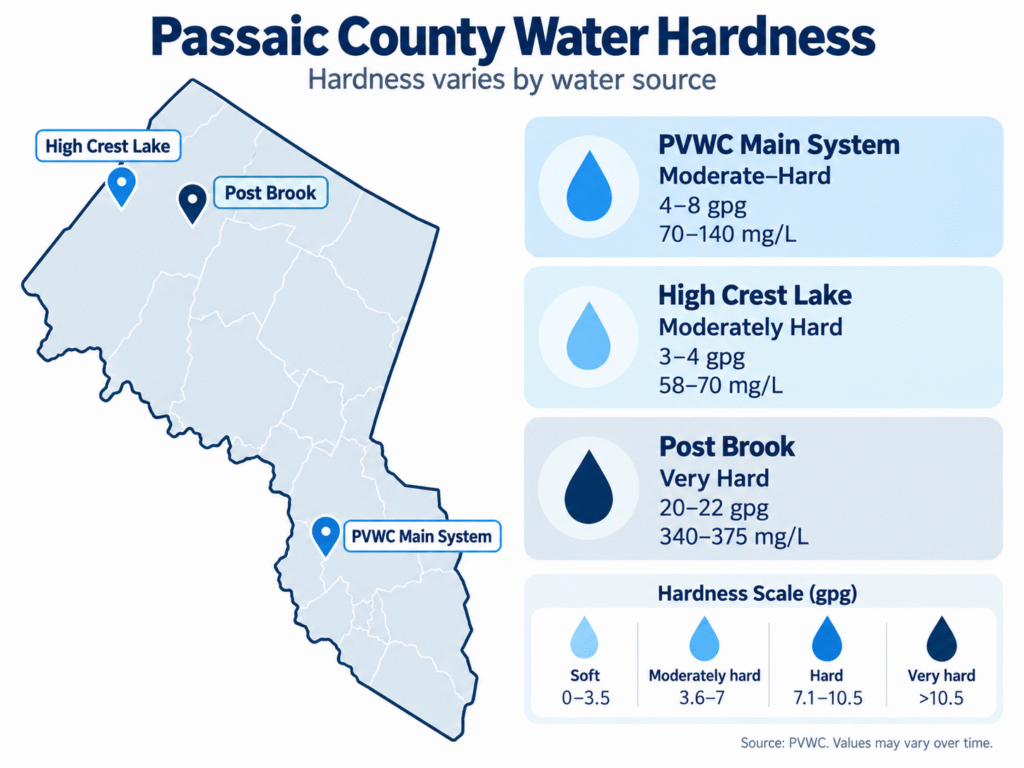
Passaic Valley Water Commission provides a useful example of just how much hardness can vary within the same general part of North Jersey.
Its current water-quality information shows that its main system typically ranges from approximately 4 to 8 grains per gallon, or roughly 70 to 140 mg/L, putting the water in the moderately hard to hard range.
But its Post Brook system in West Milford, which is supplied by groundwater wells, has reported hardness of approximately 20 to 22 grains per gallon—or 340 to 375 mg/L. That is very hard water.
PVWC’s 2026 Drinking Water Quality Report, using 2025 data, also demonstrates how different individual sources can be. Hardness at the Little Falls treatment plant ranged from 106 to 242 ppm, while other sources listed in the report had considerably lower hardness.
This is why saying something like “the water in Passaic County is 8 grains hard” can be misleading.
It depends on the specific water system and source supplying the property.
What About Morris, Essex, Bergen, Union and Somerset Counties?
The same principle applies throughout North and Central Jersey.
Homes in Morris, Essex, Bergen, Passaic, Union, Somerset, and surrounding counties may be supplied by very different combinations of groundwater and surface water.
For example, the Morris County Municipal Utilities Authority supplies groundwater from local aquifers to a number of municipal and private water systems in Morris County.
Other communities may receive reservoir water or water from large regional systems.
Private-well homes introduce another variable altogether because the chemistry depends heavily on the geology immediately surrounding the well.
So rather than assuming that everyone in a particular county has the same water hardness, think of North & Central Jersey as a patchwork of different water sources.
Why Can Two Homes in the Same Town Have Different Water?
It seems counterintuitive, but it can happen.
There are several reasons.
Different water systems
Some municipalities have more than one utility or pressure zone serving different neighborhoods.
Blended water supplies
A utility may combine water from multiple reservoirs, wells, or neighboring systems.
The blend may change based on demand, maintenance, drought conditions, or the time of year.
Private wells
A homeowner with a private well may have completely different water chemistry from a neighbor receiving municipal water.
Plumbing and existing treatment
One house may already have a water softener, whole-house treatment system, or other equipment affecting the water at the tap.
This is another reason that a water-quality report is useful, but it does not always tell you precisely what is happening inside your individual home.
How Can I Find Out How Hard My Water Is?
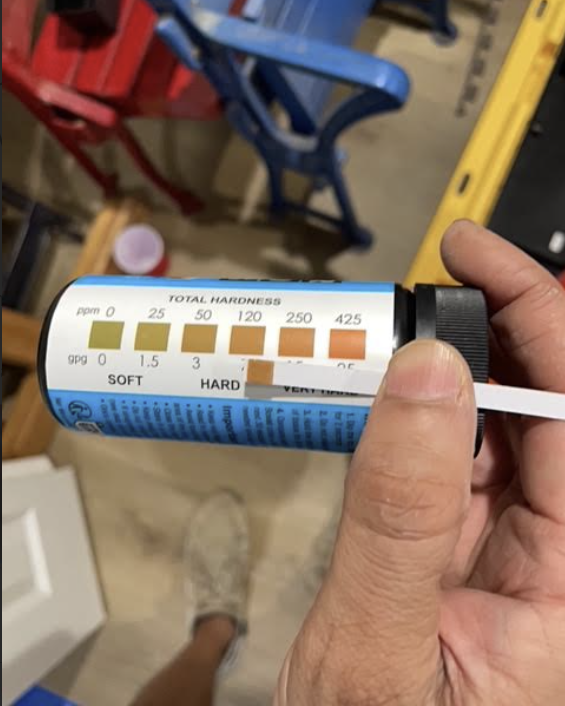
There are three good places to start.
1. Check your utility’s Consumer Confidence Report
Public water systems publish an annual Consumer Confidence Report, or CCR, explaining the source and quality of the drinking water they supply.
Hardness may appear under terms such as:
- Hardness
- Total hardness
- Hardness as CaCO₃
- Calcium carbonate
The New Jersey Department of Environmental Protection also operates a Drinking Water Viewer that allows homeowners to search for their water system by municipality or county and review water-quality information.
Utility reports are an excellent starting point.
But remember that the number may represent a treatment plant or overall system rather than exactly what is coming from your faucet on a given day.
2. Use a home hardness test
Home test strips can provide a rough indication of hardness.
They are inexpensive and helpful if you simply want to know whether your water is soft, moderately hard, or very hard.
For equipment sizing, however, a more precise measurement is preferable.
3. Have the water tested at your home
Testing the actual water entering the house gives you the most relevant number.
This is particularly helpful if:
- You use a private well
- You already have a softener but still notice scale
- Your utility uses multiple water sources
- You recently moved into the property
- You are considering installing treatment equipment
At Niagara Water Conditioning, we prefer to understand the actual water conditions before recommending a system.
When Does Hard Water in North Jersey Need Treatment?
There isn’t one universal number at which every homeowner needs to install a softener.
Hardness itself is not generally considered a drinking-water health concern. Instead, it is primarily a household and equipment issue. The USGS notes that hard water can contribute to mineral buildup in plumbing, fixtures and water heaters while also reducing the effectiveness of soaps and detergents.
The decision therefore depends partly on how the water is affecting your home.
You might consider treatment when you’re regularly dealing with:
- White scale on faucets and showerheads
- Spotting on glasses and dishes
- Soap scum
- Poor soap and shampoo lather
- Scale in kettles and coffee makers
- Mineral buildup in appliances
- Frequent cleaning and descaling
As hardness increases, these effects generally become more noticeable.
A homeowner with 4 or 5 grains of hardness may decide treatment isn’t necessary, while a household with 15 or 20 grains will typically notice the effects much more readily.
What Does a Water Softener Actually Do?
A traditional residential water softener uses a process called ion exchange.
Inside the softener is a resin that attracts calcium and magnesium ions. The system exchanges those hardness minerals for sodium or potassium ions as the water passes through.
Periodically, the system regenerates using a salt solution to clean and recharge the resin.
The result is softened water entering the home’s plumbing.
A properly configured system should take into account:
- Water hardness
- Household water consumption
- Number of people in the home
- Available flow rate
- Iron or other minerals in the water
- Equipment capacity
Simply installing the largest available system is not necessarily better.
A Water Softener and Water Filter Solve Different Problems
Hardness is also important to distinguish from other water-quality concerns.
A whole-house water filter may be designed to address sediment, chlorine, taste, odor, or particular substances in the water.
A water softener is primarily designed to deal with calcium and magnesium hardness.
Some homes need only a softener. Others may benefit from filtration. Private-well homes can have additional issues such as iron, manganese, low pH, or sulfur odors that require a different treatment approach.
That is why testing first is important.
The Bottom Line for North & Central Jersey Homeowners
So, how hard is North & Central Jersey water?
There isn’t one number.
North Jersey can range from relatively soft water to very hard water exceeding 20 grains per gallon, depending on the home’s water source. Geological conditions mean that hard groundwater is common in parts of northern New Jersey, while homes receiving reservoir or blended municipal water may experience substantially lower hardness.
The best approach is simple:
Find out what water system serves your house, check your utility report, and test the water at the property before deciding whether treatment makes sense.
Not sure how hard your water is?
Niagara Water Conditioning has served homeowners throughout North and Central New Jersey since 1963. If you’re dealing with scale, spotting, soap residue, or simply want to understand what’s in your water, we can help you determine the right next step.